By Rocio Ferro-Adams 5 August 2024
Published in draft on 15 August 2024
What are the new challenges ahead?
The outcome of 4 July 2024 General Election brought with it a new Labour Government, not seen for 14 years in the UK. Not since the 2010 Coalition Government of a Conservative-Liberal political coalition, that brought about the end of the Labour Gordon Brown Government. There have been five Conservative Prime Ministers, all characterised by their own personal styles as leaders and as statesmen and women, their impact on international relations and on the state economy has been specific and is covered in some detail by political commentators. It is a time to re-set the nation, to address some of those issues, as the Labour Party has presented in it’s Manifesto 2024. This is a good start to initiating the change, necessary to move forward with progressive policies.
Labour has been in opposition for 14 years and the General Elections results for 2024 have provided a very large majority, which will provide an opportunity to reset the relationship between the Government, and the electorate. The Labour Manifesto 2024 is a key document to refer to. Announcements on policy since the 4 July will engage Parliament through debate and legislation, and will engage the Civil Service through reform and restructuring, and the public, by developing trust in public services and standards in public life; improving employment opportunities for all, reducing local government debt to deliver services. Delivering green policies through Great British Energy and green infrastructure is one example, where jobs can be created, and skills can be developed to tackle pandemic recovery recommendations. As well as fixing the NHS and improving public pay and nationalising aspects of the railways.[1]
It promises modernisation of UK institutions, and Constitutional Reform in the House of Commons and an Ethics and Integrity Commission. Labour faces increased pressures in various areas, and it is unlikely to meet everyone’s expectations, without considerable challenges. It will therefore need to make political and policy compromises at times; as it inherits a difficult economic purse at The Treasury (HMT), with limited scope for economic reform (unless it takes a radical approach towards reform). Given the authority bestowed on it by a large Commons majority, and the powers of Government, Labour can pick-up from its Manifesto, what it can politically achieve, and on assessment from officials, decide what capabilities it has, to deliver an ambitious re-setting programme. This will be a challenge in the first few months.
There will be Bills on the wash-up on legislation from the previous Government that officials will want to advise should be carried over into a new Parliament and for administrative reasons should continue. The Executive has every right to refuse or disagree on old Bills, and new teams of officials will be asked to produce new Government policy and legislations, which it can undo within the law, what a previous Government has previously instructed and provided for its bureaucracy. Transition is a challenging time in the first few days and weeks, and will take months, whilst public services continue to be delivered. It is natural to have some period of normal working tensions as civil servants adapt to changes, and policy teams disband or are created. The UK Civil Service by tradition is apolitical, serving any Government and has few political appointments, despite its highly political nature.
Election Outcomes
The General Election provided a 59.9 % turn out amongst the British adult population eligible to vote, this was a reduction of -7.4% and all 650 seats were returned. The first past the post electoral system provided a Labour majority. BBC data and parliament provided the following on 4 July which were:
| Party | And % share of the vote | Since 2019 |
| Labour | 33.8% | + 1.6 |
| Conservative | 23.7% | -19.9 |
| Reform | 14.3% | +12.4 |
| Liberal Democrats | 12.2% | +0.7 |
| Green | 6.8% | +4.1 |
| SNP | 2.5% | -1.4 |
| PC | 0.7% | + 0.2 |
| Other | 6.1% | + 3.1 |
Labour (411) Conservatives (121) Liberal Democrat (72) SNP (9) Sinn Fein (7) Independent (6) DUP (5) Reform UK (5) Green (4) Plaid Cymru (4) Social Democrat and Labour Party (2) Traditional Unionist (1) Alliance (1) Ulster Unionist Party (1) Speaker (1) [2]
The SNP lost many seats, returning an overwhelming Labour win in Scotland, not seen since the 1997 general election. The Welsh Labour Party, despite losing its First Minister, has retained it hold over the Assembly and Country. Where the Conservatives once dominated, they have found themselves challenged by Labour or Reform in England, who have brought with them support from the right and extreme right, despite seeking for support amongst centrist voters, the Conservatives were pushed out of seats. And in spite of a return to a two-Party System, and 411 seats to the Government, plurality remains a feature of Parliament. You could argue that it has always existed, but it is the challenge from Reform in some boroughs, which means that there is significant challenge at a future election from a none-traditional Party, largely seeking election on a populist and anti-immigration reform platform.
This is a new feature of the UK political system, not yet experienced in Parliament as a political entity, with little political history, or development in traditional political philosophy within its Leadership, to reflect upon. It is relaying on modern rhetoric and a younger electorate with little political experience, and it is using this as a strength to incite forced change, which appears more unsettling than had been previously assessed. It is a party now associated with some of the chaos on English streets, despite its Leader trying to evade accusations of association with the English Defence League (EDL), supporters were told to vote Reform.
The next five years and the next election in 2029 will be one of the most important elections Britain will face since before 1945. Labour has five years in which to test its policies and to make those work to produce the ‘democratic change’, on which it was elected. The hard-right also seem to feature in the electoral base of Reform, who are at times seeking affiliation with a Party, to legitimise a negative view on immigration. Not far behind them are the right-wing of extremists in the UK who feature in much smaller numbers, and often pose a security concern, with their slogans and rhetoric that are divisive and have fostered tensions amongst multi-cultural communities for generations, but they have faced some disdain from the general population in England, Scotland, and Wales who have voted instead for a Labour Government.
Labour must stay and remain deeply root to their policies and history, or risk letting Reform UK run the agenda in five years’ time. The Government must reform as they plan, within this window of opportunity when there is goodwill in Parliament to work towards a better outcome, in order to strengthen democratic institution for the future and build trust with the public; where public services and public institutions are in crisis, such as the Department for Works & Pensions, the Home Office and Policing, the Justice system, Universities, appointments to the House of Lords, maintaining standards in public life, and tackling disparities in educational attainment; housing, employment, health and life expectancy; remain major social issues.
Labour has inherited economic problems and a crisis in the NHS. It must be careful not to create a crisis as it works towards greening policies, or closing industries before people are ready to transition, but also it must not loose pace with its own progressive reforms. Britain must also protect some of its own products or industries or seek to replace them sustainably without causing greater economic shocks through unemployment. There must be real and sustainable careers, not just for the young, but those in the middle of their careers who are supporting families, paying for future and existing pensions, higher taxes and paying for education through taxes and university fees for younger generations to come. Many students without parent support face debt and student debts which are likely unsustainable to a wider population – as many young people are unable to make their repayments, or plan for a future generation without substantial sacrifices.
One quarter of the population eligible to work is unable to do so, through lack of opportunity and access to sustainable and appropriate quality work. More will need to be done to create new jobs. A radical approach to change policy design may work towards modernising government thinking, expectations and capacity within Government – to enable better delivery of policies.
Manifesto Commitments
The King’s Speech
The King’s Speech outlined a programme of reform focused on security, fairness and opportunity for all. It included the following list of about 15 proposed pieces of legislation:
- A Draft Audit Reform and Governance, Pension Schemes Bill. (Tax and spending changes, subject to independent assessment by the Office for Budget Responsibility. To strength audit reform and governance – pensions schemes).
- An Industrial Strategy Council for Economic Growth – to establish an industrial strategy and encourage investment.
- A Planning and Infrastructure Bill, to get Britain building – encouraging industry, skills and new technology to grow.
- People Employment Rights Bill – a New Deal for working people.
- An English Devolution Bill – for greater Devolution of decision-making by giving more powers to the Mayors and Combined Authorities, to harness economic growth for local communities.
- Better Buses Bill, so local leaders can take control of transport.
- Passenger Railways Service (Public Ownership) Bill, Rail Reform Bill, to bring forward legislation to improve the railways, reforming franchise for railways, for Great British Railways, and to bring 8 operators under public ownership. Improving connectivity of the railways.
- Measures to remove the exemption from value added tax for private school fees. To fund 6,500 new teachers.
- Skill England Bill – to reform the Apprentice levy to encourage employers to invest in these programmes.
- Renter Rights Bill and Draft Leasehold and Commonhold Reform Bill. Greater rights and protections to people renting their homes, including ending no fault evictions and reform grounds for possession 9.
- A Football Governance Bill and a separate Mental Health Bill (amendments to legislation)
- A Tabacco and Vapes Bill, to increase the age at which people can buy these products and to limit the sale and marketing of vapes.
- Armed Forces Commission Bill and a Duty of Candor for public servants [Hillsborough Law].
- A draft Equality (Race and Disability Bill], to enshrine the full right to equal pay in law.
- A Council for the Nations to be established. And a House of Lords (Hereditary Peers) Bill.
- Northern Ireland Troubles Legislation repeal to be replaced with Legacy Reconciliation Act
Following on from these legislative commitments, economic stability would be the result from adherence to sound fiscal rules, and an enhanced role for the OBR on tax and spending as announced. Also the new Bills on reforming audit and good governance, and for pensions, which will strength the tax system. The Government will pursue economic growth, and priority will be based on wealth creation for all.[3] It promises a new deal for working people, and an end to exploitative working practices, and enhanced employment rights. Soo restrictions or limits may be placed on those working on AI. Greater devolution is also being promised, and a Reformed House of Lords, which is too large and unbalanced, and modernisation of the House of Commons.
The Brown Reforms were not described in any detail, although a Great Council of the Nations was announced. Both a Great British Energy Bill, a Sustainable Aviation Fuel Bill and a Water Special Measures Bill were mentioned. This has included a Border Security, Asylum and Immigration Bill and a further Crime and Policing Bill. There was an emphasis on much needed equality and new Equality (Race and Disability) Legislation. Maintaining the Armed Forces, and nuclear deterrence, whilst supporting Ukrainian membership of NATO, and supporting NATO are key features of UK commitments to defence and security. The Government has committed itself to a two-state solution for Israel and Palestine, and the PM has re-set the view of Government about the crisis experienced by Palestinian people which is more empathetic to their plight and their need to protect basic human rights and nationhood in the Middle East, which is viewed as an international commitment.
Transfer and evidence of statesmanship and constitutional propriety
In terms of transfer from one Government to the next, from immediate external media public assessment, constitutionally, that transfer has met expected standards of propriety, with immediate effect, the calling of the results and acceptance of the new Party to form the new Government. The resignation of one Prime Minister outside Downing Street and the appointment of new Prime Minister, on meeting the King to call on the formation of His Majesty’s Government was followed by the appointment of His Cabinet, by Keir Starmer, at Number 10 Downing Street. The first Cabinet Meetings were held within the first few days, and international phone calls with other world leaders took place. These are all expected constitutional processes by custom and convention, followed by a State Opening of Parliament on 17 July 2024, and published statements on the legislative programme.
Labour party Manifesto – 5 National Missions
Kier Starmer outlined the 5 key Labour Missions if elected in a Manifesto in June 2024 on which the Party was elected on 4 July 2024. “To stop the endless chaos that has directly harmed the finances of every family in Britain”. The purpose of which would be to work towards a national renewal, to rebuild the UK, to serve the interest of the British public. Restoring hope for a national purpose, a “collective national” purpose. He identified two significant threats to the national character of politics in the UK. “First, that politics should be driven by a sense of service to the country, not consideration of party or self-interest”.[4] “Second, that if you work hard, then whoever you are, wherever, your start in life – Britain is a country that will respect your contribution and give you a fair chance to get on”. The theme of collective national purposes aims to unify people of all backgrounds, and the idea that it is equality of opportunity and respect of everyone’s contribution, matters in the psyche of voters. Having witnessed isolation of groups of people, struggling during10 years or more of austerity policies, Brexit and then the Covid-19 pandemic, the electorate voted for unity.[5]
The concept of Service is also fundamental to working people and people who vote Labour. It provides for a link to the past and present British values, post-war and now. It reflects the ability of people to trust those that are in power, not to abuse that trust, or to aggrandise their positions for self-benefit. The view is for those who voted Labour that the Conservative Party did not behave appropriately and those in power since 2010 have abused the trust and authority bestowed on them by the public.
Areas of most concern to Labour was the chaos brought about by successive conservative governments. “Visible decline – families weighed down by soaring mortgages; people waiting on trolleys in A&E, sewage in our rivers – . “The result is a vicious cycle – decline feeding off chaos, chaos feeding off decline – that will continue to return”. Labour was offering the only possibility of breaking this decline at the July 2024 Election. The solutions, few would disagree, are the return “to good government, national security, secure borders, and economic stability”. It also declared and won on this Manifesto a large majority on the points that, “so much of what Britain has been through in the past 14 years is explained by a Conservative failure to face the future”.[6]
Turning the page on Conservatism is the keyway forward, in ‘an age of insecurity’, which is what we are experiencing in modern Europe and Worldwide. With war in Europe and the security review showing problems with defence spending necessary to secure borders and the demands of War in Ukraine and potential further escalation in Europe. There is a war which NATO will need to prepare for, as the borders of the Eastern Flank are porous, and countries there are experiencing Russian influence and interference. There is an expectation for diplomacy to resolve the issue, but state borders need to be secured. Northern Europe has indicated that it also prepared to push back, and this reality has begun to feel much closer to home in Britain than in previous wars. There is also a Manifesto Commitment to modernise development, through government. “We will once again be a good partner for international development, and a defender of the international rule of law”. Using Britain’s unique position in NATO, the UN, G7 and G20 and the Commonwealth to address the threats faced.[7]
Reinforcement of the countries defence will remain important and soo to British Steel, which is needed to provide for the transformations in infrastructure to both defence and the environment and housing infrastructure. To build new infrastructure Britain will need to provide steel and to relay on its own industries. It will bring forward “a defence strategy, aligned with economic priorities”; Labour cannot be seen to be in contradictions between Departments on these issues, British Steel works must be up and running, to match those commitments. “Labour will also create a national directorate to create a strong defence centre capable of leading Britain in meeting the increased threats we face”.
“Labour will support efforts to hold Putin’s Russia to account for its illegal war, backing calls for a Special Tribunal for the Crime of Aggression. We will work with our allies to enable the seizure and repurposing of frozen Russian state assets to support Ukraine.”[8] Britain will continue to work towards Ukrainian NATO membership. This includes maintenance of a nuclear deterrent. It will continue to support AUKUS, the trilateral security partnership with Australia and the US, seeking to manage the relationship with China Strategically, and so it will begin a process of auditing UK-China bilateral relations. Defence of Gibraltar and Falklands and overseas territories remain a priority, in defence of what is UK sovereignty and a right to self-determination.[9]
Investment is surely needed to re-build the country, investing in local infrastructures and institutions. “The working people of Britain came together in the pandemic- missed weddings, funerals and last goodbyes – to save the lives of people they will never meet. They dug deep in the years of austerity, to keep delivering public services”. [10]No one will deny how difficult these times have been for those struggling, left unemployed or those deskilled to work in lower paid jobs. The manifesto also describes the cost-of-living crisis, which has been felt by the majority of voting people, those disempowered and in less lucrative positions under the Conservative Government, have been well documented by historical press stories and academic work.
The Manifesto states that Labour will provide a new Ethics and Integrity Commission, Modernise the House of Commons, immediate the reform of the House of Lords, reset the relationship between Westminster and Holyrood, Cardiff Bay and Stormont, introduce votes at 16. It is early days, what Government may be able to negotiate with the capacity it has is still to be tested. How willing Parliament will be, given considerably high levels of goodwill and given the large majority Labour now holds, expectations on this should be high, that the numbers will be reduced in the House of Lords, and that there will be Reform of the Appointments Commission.
Yet there is little belief that there will be radical reform of the House of Lords by academic experts, given history on the issue in 1997, Reform of The Lords, became a major compromise and a two-stage process, of which one was only fully implemented, reducing number. Should the Brown Commission Reforms be actualised, these would radically Reform the Chamber, the Constitution and the politics of the House of Lords representing the nations, rather than single issue, or single party politics.[11] The political will of Parliament has yet to be tested on reform of both Houses. There is more optimism, from say UCL Constitution Unit, that House of Commons Reform may be easier if transformation takes place via a staged process of Reform.
A House of Lords Committee note published on 11 July, describes a likely reduction in the number of hereditary Peers. But there is no explanation as to how that will be done, and whether they will be removed ‘swiftly’ or through elections as vacancies arise[12] Removing all hereditary Peers, will reduce the numbers by 90, to 729.[13] The reduction may impact some Conservative numbers in the Chamber, which stand at about 16% of the total number and where 17.5% are Cross Benchers. Labour have only 2.2% of the hereditary seats in the House of Lords. Secular Societies have in the past called for a reduction in the Lords Spirituals on the same arguments that Hereditary Peers are not justified, but there are also good arguments for keeping those who are representatives of the moral compass of faith communities. 181 Lords will be 80 on the 2024-25 Session, ready for retirement reducing the hereditary Peers by 44%.[14] All three Parties, Labour, and the Liberal Democrats will loose about half of their hereditary Peers, whilst the Conservatives will loose just over one third. There may also be a negotiation on the retirement age of life Peers, equal to that of judges and bishops, allowing for the refreshing of the Chamber. Reform may take place in stages and The House of Lords Act 1999, may need to be amended and too, the House of Lords Appointments Commission.[15]
But there should be an expectation that numbers in the House of Lords should be reduced given the large increase in numbers since 2010. There is little appetite to increase the numbers. If in reality the political will is to change the focus of the House of Lords by legislation, to one which includes the principle of, Representation for the Regions in Parliament, rather than just a Council for the Regions, and in some legitimised way, then this could amount to significant Constitutional Change for the Chamber. But there has been no public announcement other than that legislation mentioned in the Kings Speech. “The Manifesto set out a commitment for “both houses”, and in “the longer term, replacing the House of Lords, with an alternative second chamber”.[16]
It is the following Constitutional change which would be significant. That Labour would “seek to improve the national and regional balances of the Second Chamber”.[17] Peers do not currently officially represent any Region of the UK. The Gordon Brown proposals are more radical and propose to replace the Second Chamber with an Assembly of the Nations and the Regions. Smaller than the House of Lords and elected.[18] Modernising the House of Commons may look to drive up standards, reduce the amount of time MPs work in second roles, and it will consider if they should at all. It also calls to reform procedures on MPs Private Members Bills. Bringing more constitutional change in giving votes to 16–17-year-olds, intended to balance the rights of Welsh and English Voters – this would also change aspects of rights for 1.6 M people in the UK. [19]
Foreign Affairs, Gaza, Ukraine and EU
The message from new Prime Minister has been one about re-setting the relationship between institutions and in international relations. At home he announced five missions. Within a few days he had already embarked on a number of visits, such as the meeting with Olaf Scholtz, German Chancellor and President Biden of the USA on 10 July, as well as President Zelenskyy ahead of a NATO summit the following day, at which he gave a speech on collective security, and about Ukraine. Providing a commitment to increase UK defence expenditure to GDP to 2.5%. [20] He also has stated that the UK will not return to the EU in his lifetime, indicating that Britain is not considering an application to re-join, but it is seeking to develop improved economic ties, by regenerating a new spirit of cooperation, at the 18 July meeting of European Political Community, which was established by French President Macron.
His Foreign Secretary, David Lammy also travelled to the EU on 7 July to build new relations on trade, then Germany, Poland and Sweden. Meeting with President Zelenski as well, to discuss artillery commitments to the war effort int Ukraine.[21] Whilst in German, he mentioned a more balanced approach to Israel -Gaza. And it is expected that the Arab Israeli Peace Process, which has been underway will consume large amounts of diplomatic time and resources in the future. Poland’s Mr Sikorski was reported to have said that the “new polish government shared something in common with the incoming Starmer administration”.[22] Both, Mr Sikorski said that they were “the product of the public being tiered with enthusiasts on the nationalists’ side of politics”, although nationalism is still a feature of the new polish government. Mr Sikorski said he looked forward to “a more pragmatic approach” from Britain to its relationship with Europe and said the two ministers had discussed some creative ideas”. (Paul Adams BBC News).[23]
Mr Lammy has been vocal about Britain’s position with regards to Ukraine and Mr Putin’s form of fascism, all three nations are supporters of Ukraine in relation to Russian aggression. He has spoken of Britain’s unshakable alliance and in seeking a broad-ranging UK-EU Security Pact, to enhance and underpin co-operation. He arrived in India on 24 July 2024, to unlock the full potential of the UK-India Partnership. He seeks a free-trade agreement that will benefit both countries and partnership on global initiatives, such as climate resilience, through an Indian-led global initiative to build clean power access with other nations and smaller island states. There is a longstanding historical arrangement between Britain and India and resetting those relationships is an issue for both countries.[24]
Published Statements from the Foreign and Commonwealth Office on 14 July state that “Foreign Secretary to [will] call for immediate ceasefire, the release of hostages, and a rapid increase in humanitarian aid into Gaza. In meetings with PM Netanyahu and President Abbas, David Lammy will make the urgent case for a credible and irreversible pathway towards a two-state solution. The Foreign Secretary Announced a £5.5M to UK-Med to support their ongoing work to provide humanitarian assistance and medical treatment to those in Gaza”. [25]He visited Gaza and the Palestinian territories and has committed £10M in aid to the Palestinian Authorities (PA), which Israel refuses to give sanction and authority to, in Gaza.
This is likely to be a long-term and diplomatic commitment for Britain for some time. It has the challenge that the current Israeli Government will work with only approved affiliated bubbles, deemed secure in Gaza, but has refused to work with the Palestinian Authority (PA). Which means that it is concerned that Hamas could still despite being weakened, have some hold over the territory, this coupled with the very large civilian deaths of Palestinian people, means that the international community knows that Israel cannot continue without making diplomatic in-roads. The UK has dropped its case at the ICJ on challenges to the arrest of President Netanyahu.[26]
Israel may need to seek to compromise to regain international standing with regards to the treatment of the Palestinian people, their protection as an entity-group and their human rights under international law. Interviews of the Foreign Secretary before appointment, suggest that Labour will seek to adhere to the ICC’s ruling and ICJ arrest warrants for the PM and Leaders of Hamas. “The architecture that was created after the second world war, the rules-based order that we believe so much in, the international legal structure -.. we are signatories to the statute of Rome…We have been very clear that in the Labour party, we believe in rules-based order. We believe in international law [and] in the separation of powers”.[27] (The Guardian Sunday 23 June 2024 Patrick Wintour).
Assessment from the international press suggests growing fears of escalation along the Israeli and Lebanon borders, of violence as Israel seeks to destroy the leaders of Hamas living in neighbouring countries. In doing soo local populations of other states are also affected and killed, which is likely to raise more cases of concern about breaches of international law by Israel in future. This becomes more evident as other foreign governments decide to take diplomatic routes more often, instead of the route towards violent reprisals. The fears of escalation and breaches of border sovereignty by Israel could result in full-scale regional war. President Biden has committed to spending the rest of his Presidency, which ends in November, to [negotiating] a ceasefire. (The Economist 2 August 2024)
The Environment and climate crisis
At the same time the Secretary of State for Energy Security and Net Zero, has announced the creation of Great British Energy a publicly owned company (with private business support), with a Head Quarters in Scotland, and a Bill being introduced to Parliament. It has also announced working with the Crown Estates owned by the Monarchy. The primary reason being the environmental and state security.[28] The announcement by Ed Miliband, the Secretary of State, states “ More than two years on from the Russia’s invasion of Ukraine, families and businesses continue to pay the price for Britain’s energy insecurity”, as indicated in the rest of the statement the cost of energy is unlikely to be sustainable for many people, at the same time government has decided to cut energy support to many people unless they are living with someone over 80 years old.[29]
It is also climate crisis which is a major challenge. The security aims may also provide some global leadership amongst G7 countries on the speed at which transition should happen to enable a real reduction towards net zero, investment in green energy will produce jobs opening-up the Green Energy sector, urgently needed for employment, working with the National Wealth Fund, and the UK Infrastructure Bank, employers and the Unions – creating jobs. Their returns and profits would benefit taxpayer and billpayers. “In 2024, the answer to all these challenges point in the same direction: investing in clean energy at speed and scale”, his statement recognises the need to guarantee our energy security and the need to speed up the transition away from fossil fuels. Writing in The Guardian he described in July the problems created without achieving green targets, in a number of interviews he has stated that “British-based renewable energy is the cheapest and fastest way to reduce vulnerability to volatile global fossil-fuel markets. The faster we get off fossil fuels, the more secure we become”. [30]
The aim is to respond to the environmental problem; by becoming a ‘clean-energy superpower’, this is also an emergency response to the over reliance on Russian fossil fuels in Europe, which often find ways into all European markets. Despite sanctions and reliance on fossil fuels, he has caused significant problems, and the solution has been to lift the band on windfarms and a solar panel revolution experienced, elsewhere around Europe and the world. This may include new technologies in “floating, offshore wind, tidal, hydrogen generation and storage, and carbon capture”. Where community owned energy generation may help “relieve pressure on the transmission grid”. Partnership with the Crown Estates could produce new offshore wind development, with a “potential to deliver 20-30GW of extra offshore wind sea base leases to the market by 2030”. Leverage costs are estimated at £30-60bn.
Labours Mission statements include the political view that these things such as the environment are like public goods, which is in line with Sustainable Development Principles and frameworks held by the UN on Climate Change and reflect prior commitments at CoP meetings and within International Treaties. Also, the realities of disparities between the wealthy and the poorer parts of Britain have hurt – not just because of perceptions, but that large parts of the population have been isolated from opportunities to contribute and to help growth the economy. These have been set out in two statements “We already have public ownership of energy in this country, by foreign governments. The policy of this government is that it is time for the British people to also own things again and build things again….Other countries [like China, and parts of Northern Europe] have also grasped the opportunities of investing in clean energy, but Britain is being left behind”. These feelings of being left behind are evidenced from studies on the impact of Austerity policy and post-covid pandemic.
More historic work will need to be done over time to analyse the last 14 years and its true impact on workers, trade unions, and across various groups, including those classified and known to be more vulnerable. Future work must see the cost assessment of creating a Great British Energy Company to the public, and what benefit and social impact it will have through a detailed impact assessment on legislation. The intention to prevent international fossil fuel price shocks, will only be tested in time, and when the circumstances arise and if policy and technology is ready in time, ahead of any such event, such as that created by fossil fuel price inflation, or through a prolonged war in Ukraine.
Fiscal Planning and the Economy
A Labour commitment to economic growth has been described in the Manifesto, to kickstart the economy and to boost growth, using a National Wealth Fund to boost growth everywhere. Including in planning reform to build 1.5M new homes. Its mission is defined to address lower productivity, wage inflation and stagnation in certain area, which has left British families significantly poorer than those in France or Germany. Employing ‘securonomics’ – government does not need to grow, but it does need to get better and smarter. LSE publications and seminars from 2023, indicate that it is Government capacity that needs to be reviewed- it would make sense for this to be done externally through a skills audit, reporting to a new Cabinet Secretary, Parliament or Cabinet office, but this should be made public, and it would provide for greater transparency.
The Institute for Government has published “20 Ways to improve the civil service”, on 31 July 2024, a report outlining how government must improve and audit skills, to avoid poor management capture, it would make sense to avoid only peer to peer review, as cycles of poor management can feed off one another. Reform of the civil service is being recommended in the report in ways which are recognisable and not unusual.[33]
It will seek to “upgrade ports to £1.8billion and build capacity chains across the UK. £1.5bn, to build new giga factories so our automotive industry leads the world, £2.5M to rebuild our steel industry, £1 bn to accelerate the deployment of carbon capture and £500M to support the manufacturing of green hydrogen”. [31] Government statements back media coverage on funding statements in July-August.[32] It will undertake a review of the pensions markets to consider what further steps are needed to improve pensions outcomes and increase investment in UK markets. What will happen to the Conservative triple lock promise on pensions, will probably be an investment opportunity for Labour to use pensions investments differently.
Capping corporation tax at 25%, we will retain a permanent full system for capital investment and allow for small business growth. And it will give firms greater clarity on what qualifies for allowances, to improve business investment decisions. In England, Labour will replace the business rates system, leaving open the possibility to tax large energy corporations, or excessive profits, which could be used as public revenues.
There will be investment in information infrastructure, which will boost the information economy, a full gigabit, and national 5G coverage by 2030. Royal Mail will also need to have improved delivery, and the Manifesto is committed to improved Governance for the Service. There is no mention of re-nationalising the Service as a public good or investment.
Rachel Reeves the first female Secretary of State for His Majesty’s Treasury the new Chancellor has asked to rebalance the books in aways which means cuts to Government, and savings. Labour also has stated in the Manifesto that it will create government that works in partnership with business and trade unions, local leaders and devolved governments. It will introduce a new industrial strategy, with a competition and regulatory framework that supports innovation, investment and high-quality jobs. Building on Britain’s successful Financial Services sector, supporting new technologies, open banking and open finance, along with a pro-innovation regulatory framework. It will need to look at the automotive car industry, life science and creative sectors. The Two Child Benefit Cap remains, and its continuity at the moment, is contentious as people are concerned about the impact on children, as poverty has risen substantially amongst vulnerable groups. There will be spending cuts in the October Budget and a Spending Review announced.
Restoring economic growth is a priority in the new government. Her speech on 5 July recognised public priorities. She announced immediate action on the 8 July, with commitments to local growth.[34] In addition, she has committed to build on the Strategic Spatial Energy Plan, developed by the National Energy Systems Operator to speed up clean water, after several months of water quality problems.[35] She has publicly highlighted a shortfall left behind by the Conservatives. She identified gaps in Finances; “had Britain grown at the OECD average from 2010Q2 to 2024Q1, the receipts should have been £58bn higher in 2023-24. The UK economy would be £159bn (6.9%) larger on an annualised basis in 2024 Q1, if it had continued to grow at the average rate seen between 1997 Q2 and 2010Q2.” “Tax receipts would have been £6.4bn higher in 2023-24”.[36] UK GDP would be 1.4% larger by the end of 2025 if it grew in 2024 and 2025 by the G7 Average”, these have not been good indicators for Britain. Growth has been very affected. [37]
What are key issues facing Labour in Government
The consequences of a failure to grow within expected levels (set up international institutions), have witnessed a fall in living standards, which has weakened Britain’s resilience and has in part, left it open to external influence. Not meeting expected growth targets does need to be articulated and explained by Government officials under a new Party to better understand ‘what pressures’, Government has been under over the last 14 years. This has been described as ‘lost growth’ that needs to be accounted for. Civil Servants must be open about their past advice and some investigation by Parliament would be expected, there is no reason why those areas of Government would be closed to scrutiny and review and reporting – not dissimilar to the Covid Inquiry underway in Britain.[38]
Central Government has complained of having too little information to audit spending strategically, the emphasis on less detail to enable Mandarins to make decisions, raises the question as to the capacity of Permanent Secretaries themselves to understand, and get a grip of economic issues and why they matter to their departments – economics and economic policy thinking is sluggish. From experience, there is little transfer of recognised economic policy influence on Departmental spending decisions, which focus largely on funding Departmental administration – you need both. Earlier G7 monitoring statements suggest that Britain has the lowest growth rate of all seven nations, when it should be in a better economic position to deal with the international security issues arising. External influence through a more porous led Government which has not been listening through its intelligence agencies, sufficiently, to develop the capacity to respond to the increasing chaotic and sometimes criminal behaviours, which can unbalance the social fabric of society, and which have fed off the poor economic response to the cost of living crisis.
Lower receipts mean fewer resources, but there is to be no increase to national insurance, to the basic or higher rate of income tax, or VAT. A new Growth Delivery Unit has been said to be established at the Treasury. Cuts are expected in Government Departments, but after a pay review body award. The Chancellor has announced spending cuts, to cover the £21.9bn blackhole, and a contaminated blood compensation scheme of about £10bn, with costs to protect asylum seekers being about £4bn a year, (estimates by Oxford University Migration Observation), Government estimates were closer to £1.6Bn in 2022.[39] The Conservatives may have planned to use the Reserve, but some cuts could include suspension of road projects, or savings from 40 hospital buildings.
The present shortfall will have an impact on future budgets and will need to be compensated for over time. There is no department for economic planning and the Treasury deals with the budget, the Office for Budgetary Responsibility (OBR), for independent forecasting to the Treasury. It is also important to look at the IFS for independent reports on spending. There is no evidence in the statements for a new Department, responsible for Economic planning, common to many modern democracies, which can add levels of transparency, and accountability for decisions on spending controls.
The Institute for Government have identified a problem with the approach by Government of conducting Spending Reviews, and “may not be up to the job of achieving Labour’s Mission”. The report attempts to “show how the existing process fails to align government spending with strategic priorities, and a long-term value of money”. It outlines poor use of evidence to make decisions. Which does not reflect government priorities in Whitehall department budgets.[40] Levelling up is said to have been poorly defined in the 2020 and 2021 Spending Review, to meet the aims of reducing real poverty across the country. She is being asked to ‘reset the approach’ to spending reviews, but in what way if current plans to establish spending review cycles, which are recognisable management tools for managing spending, are now considered not enough.
A department for Economic Planning may help improve understanding of detailed economic stability through the implementation of a plan, rather than spending review for Departments. Such an approach will require a change in Whitehall culture at the Treasury, as the Department would have more authority and power in Whitehall to determine the economic viability of spending over planning cycles of more regular monitoring and yearly review.
Such a process may provide institutional strength to the Treasury and prevent further capture of transparency rules and administrative controls by giving more time to Economic priorities and viable economic decisions, it would provide checks against poor economic planning consequences and decisions made collectively in Central Government, crossing over into strategic industrial plans, business and trade forecasts, even commitments to development and aid and education expenditure forecasts. For instance on the impact of education and skills across the countries, reflecting the priorities of each nation, accessing how mission critical policies are being developed – and how they impact the economy for the future. It can check collective accountability of Cabinet through an Economics Cabinet Committee, reporting to Cabinet and Parliament. This is a more radical approach than one currently being recommended by the Institute for Government. Such a Department could sit within or alongside, HMT.
The current report recommended by the Institute for Government reflects good and recognised practised by past Labour Governments, it is a means of managing the economy, seen in Government before. And it is a good attempt by the Civil Service to speak to Government. It has produced some recommendations which prevent problems with regards to Departments demands and proposes some process for Departments to realistically access their trade-offs. This is all good, but it requires an administrative mechanism which will allow greater monitoring – this in itself however, and having learnt from past experience, will not be sufficient. The current arrangements and culture of Whitehall is to push against tighter administrative controls.
The report by the Institute for Government, “How to run the next multi-year spending review”, published in July 2024, suggests a spending review process, which involves planning for spending cycles of 3-5 years (but as in previous Governments, closer monitoring of the review process, are recommended externally – otherwise these can be weakened by institutional capture and Departmental agendas). The report identifies, “ …the focus on managing over-all near-term spending during the 2010s led to poor value-for money outcomes in some areas, particularly over the longer term”, what is being proposed may not be enough monitoring or transparency if Departments continue to report in the same way at present, although the Evaluate Task Force being proposed may provide some backbone to monitoring. Parliament will also need to provide capacity with higher degrees of economic analysis, knowledge and understanding procedures, to produce quality reports. The Chairs of Treasury Committees should good economic understanding, and political members of the Committee needs to be able to deal with the economic detail described.
UK Economic planning must incorporate those frameworks. The report has sound foundations and proposal for good principles so that central government can work effectively with the OBR, it should be considered by Government as a way forward, without excluding other workable options. If the budgets are tight as predicted, expectations of ‘top ups’ under the recommendations need to be managed proactively. In response to an earlier Institute for Government Report, where it found “ that the Centre of Government – Downing Steet, Cabinet Office and the Treasury are not strategic – and government fails to define its priorities”.
It is suggested here that a more economically focused agenda, may push back on the culture that it is possible to keep feeding Departmental agendas and Mandarin institutional politics which are not immune to the capture of management interests. This can challenge the purpose of sound economic planning for the nation, which should be immune and separate from Whitehall interests. This is a huge challenge. It is a more challenging position than Whitehall is used too, but existing spending review culture exemplifies some of the policy capture experienced over successive governments, since the late 1980s. The Civil Service is used to receiving its ‘Envelopes’, but its capacity needs to be tested not just at senior levels for compliance with international law, standards, pace, resilience, ‘Nolan Principles’ plus (+ values which enable it to engage with international standards and is resilient against external influence), by calling out poor behaviours that compromise the Civil Service. Institutional weakness means that external influence can find its way into the civil service more easily.
A whole economy view, one that focuses on supporting the industry of the production of all economic sectors that arise as a priority to sound economic planning elsewhere, can guide Britain to design a department where economic planning is at the centre of what it does and can enable Departments to arrange themselves more strategically. Philosophically this includes providing education, health and social care and pensions and benefits provisions, policing and responding to crime and security issues, in balance with a strategy for economic growth through productivity. Britain must grow economically through all sectors which need a sound economic industrial base built on technology, research and development and skills in industry. It should not follow a complete neo-liberal model, expecting private industry and the markets, to carry all investments. If these are not working well or are in crisis, these become poor investments.
What challenges lie ahead for Labour. Key areas:
Brexit – to rejoin? Current voter Analysis
In an article for UK in a Changing Europe, Dr Stephanie Luke explores whether the EU would want the UK back. Redfield & Wilson Brexit Poll published on 8 May 2024, indicates that 59% of Britons say that they would now vote to join the EU, with little difference in the results polled the month before. It predicted that if there were a Referendum today, 59% of voters would say yes and 41% would say no, and would prefer to stay out of Europe.[41] There are a proportion of voters who have responded that they do not know how they would vote in such a referendum, this changes the figure to 55% of voters, wishing to re-join the EU and 38%, wanting to remain out of the European Union. There are some changes as 82% of those who voted to Remain say that they would vote to join the EU and 72% of those who voted to Leave have said that they would vote to stay out. [42] But importantly 23% of those who had voted to Leave the EU, would now vote to re-join. Of those now eligible to vote, aged 18-24 since 2016, would vote to join the EU. Further analysis showed that more than half of those under the age of 54 would vote to re-join, with the percentage dropping from 69%-54% as ages increased from 25-54. This contrasted with those aged over 55 saying that they would vote to stay out of the EU at 50% and a plurality of 65% saying that they would vote the same way.[43]
The OBR has confirmed previous analysis that Brexit cost the economy 4% in productivity potential, attempts to dismantle some further barriers to trade will be profitable. Along with stronger wage growth will help the economy.
What Is Labour’s rationale
It is in this age group , those 55 and over, where thinking, due to experience will matter most, The over 50s have wider concerns, not explored in this poll. Such as attitudes changing in Europe towards migration (as a negative or positive), the war in Ukraine and the rising tide of right-wing politics in the European Parliament. How would British MEPs manage that kind of mixed Parliament in Europe, and does it prefer to play no part in appeasing groups which are in contradiction with Labour values?
This coupled with the expense, bureaucratic resourcing and the time intensive Legislative burden of Re-joining the EU, could arguably become a distraction to Reforming and strengthening institutions which are already weak and in debt, and may be one of the many reasons why despite some real economic and security rational choices, re-joining may seem too difficult. Mixed feelings about that, coupled with the cost-of-living crisis and now the £21.9bn pressures discovered at HMT this month, under a new Government, may be some of the reasons for the hesitation.
Therefore, it is important, for analysts to begin to unpack voter hesitation, thoughts and feelings, about the wider international context and how this may impact voting expectations around such a Referendum. Only 32% of voters from this poll by Redfield & Wilson Strategies thought that “the United Kingdom should definitely hold a referendum on the question of Britain’s membership of the EU in the next five years”.[44] This figure is still low, but not unsignificant and only 22% of those polled said that a Referendum should take place within 5years. A larger proportion of people 44% of those British people polled remain divided on the question, whether the UK’s membership of the EU has been settled. Public perception is that it is unlikely that Britain will vote to re-join the EU, ‘in the near future’. 36% of those polled believe it is also unlikely in the next 10 years, with over 30% of those who voted the same way in 2016, convinced that this is likely to be the case.
Threats to the European Union
Resetting EU relations is key. There is also the unquantifiable possibility that France may Frexit, and this is an unknown which if it were to happen could knock the European Union. The rise of Far-Right MEPs in the European Parliament has at times destabilised relations in the European Parliament. In response, the snap French Presidential Elections in France, which returned a left-wing coalition, pushing back Le Pen’s Far-Right Party back into third place at home. Despite its increasing numbers in the EU Parliament. Left, Centre Coalitions and Democratic Coalitions can work together. It is their continuing threat which is of concern over stability – could Labour ever work with the Far-Right in Europe? This would be a very big and unappetising question, given Party values and ideas about immigration, equality and inclusion, and multiculturalism and tolerance – these founding Labour principles, contradict the very purpose of right-wing parties, which are largely Euro-sceptic and anti-immigration.
For now, it would appear, that it is better politically for a middle power nation, like Britain to remain out of the EU, until Europe is settled and as long as the proportion of right-wing MEPs remains low enough, not to threaten the principles on which the EU was founded – only then would a return to the EU seem more politically attractive a choice. But five years is a long time in Parliament and unforeseen events many happen.
The nature of the European wide threat is the rise of fascism and voter apathy in those nations. Voter turnout at the European Elections were lower than 50%, in Italy, Austria and Italy. In Germany it was about 63%. At the European Elections, countries that returned right-wing parties include Germany – although it came in second place after the Christian Democrats, with about 30% of the vote. It has a significant rise in right-wing support amongst some EU voters. In Germany this rose to 15.9.2%, (raising amongst younger voters). Other countries include Austria, (Freedom Party of Austria returned 25% of country vote) and Italy (Brother of Italy Party, returned 28.8% of vote, 4 % higher than the next democratic party), and France (Far-National Rally 31%, 15% ahead of any other pluralist party)[45]. The snap Presidential Election in France pushed back the FNR to third place, through a left-wing coalition of parties, suggesting France’s liberalism is not prepared to let fascism win.[46]
Should the UK wish to re-join the EU at any stage, it may be able to make alliances with centre and left parties. These right-wing parties are still in a minority in the EU Parliament, but they threaten political and social stability and can push governments to rethink their alliances at home.[47] Right-Wing parties in the future may seek to form their own coalitions within the European Parliament, intending to change, undermine the very nature of the European Union, leaving it weakened to external influence – but if figures rise, should we expect a big strategic realignment of parties.
Internal threats to security, violence and instability
The UK faces a number of threats, from external foreign forces which have been highlighted by the security forces for a number of years, from Russia and China which are described as destabilising. The police and the security services must continue to be resourced and supported to perform their statutory roles and to protect the nation from threats of violence, terrorism and criminal activity. These threats come in a variety of forms, such as modern slavery, illegal migration where victims are brought to the UK by criminal gangs, who extort money. Corruption of our institutions through fraud and theft of public money, money laundering and activity which undermines the state and public infrastructures, abuse of powers or negligence by officials in grey or dark areas. Online criminal activity of the most serious nature, networks of sleeper cells and criminals working under the radar of security officials, conducting criminal activities, are threats identified by the Home Office.
Although visible policing and recruitment has risen over the last decade, more specialised police may be recruited to deal with increasing violence and ’thuggery’, associated with extremist groups which the government is considering adding to the list of terrorist activity. This includes the riots which have spread across England and Northern Ireland this month, in London, Plymouth, Liverpool, Manchester, Southport, Sunderland and Hartlepool, Bristol, Belfast, Hull and Stocke-on-Trent. Sparked by terrible violent and isolated events in Southport, the riots have spread, and policing has been challenged by the extreme far-right English Defence League (EDL) and criminals who have used these demonstrations as an opportunity, to cause chaos, destruction of property and looting of shops.
Former Senior Police have also requested, that far-right groups should be classified as terrorists, which would give both the security services and the police forces the ability to intervene and provide more serious offences for sentencing, creating a deterrence. But also to enable better intelligence and information on these groups to be disseminated, who’s intent is to force a policy change in perspective on multiculturalism, and immigration – intent on rooting out fascistic undertone, which promotes violence and ideology, that attacks democracy, undermines academia, justice and the law. The UK Government had published a definition of fascism in July 2019, it covers definitions on revisionist history and right-wing extremism by Dr Benjamin Lee at Lancaster University. The definitions appear right and are uncontested in political sciences. The present government is considering putting the English Defence League (EDL) on a list of terrorist organisations. There was a need to be clear about the rationale for the rejection of far-right politics in Britain and this has gone a long way to settle basic knowledge about the foundations of fascism and the whipping up of populism past and present.
The government has met to discuss contingencies and security already, through COBRA (Cabinet Committee) and it always has the option to call on the Armed Forces. Instead, it has chosen to provide for more specialised policing, which can work with the security forces, who must be alert to the intelligence issues necessary to secure the nation. These groups are smaller than they claim but can cause damage and intimidation and encourage criminal behaviours. 400 people are said to have been arrested and possibly charged. The Police have also been accused of not doing enough to prevent the rioting and intimidation of communities which have taken place.
The Home Secretary, Yvette Cooper has already responded by stating that hundreds of prison places are to be made available by expanding the existing early release of prisoners – the Government had announced an early release scheme for prisoners in October 2023 of less dangerous none-violent prisoners currently in prisons, causing overcrowding.[48] This may release some of the pressures experienced in jails, creating some space for those charged with more violent offences. The Lord Chancellor later confirmed 500 prison places for prisoners at this time in response to those being sentenced for rioting.[49] (The Financial Times)
More work needs to be done to better understand how the police respond to crime, the processes in charging these kinds of criminals and the outcomes on sentencing and imprisonment, where they risk further radicalisation. Other security issues, arising include networks of Russian agents and spies who can undermine the state and its functions and who may attempt to use cyber warfare and influence to change policies through public opinion, towards Ukraine, using misinformation and conceptions of patriotism.
This is also characteristic of far-right politics, which intends to instal fascistic ideology, challenging traditional party politics and democracy in Britain. These ideas can take root, to influence social policy in government, if left unchallenged, institutions can be undermined and weakened. Similarly, the fear is that there will be influence from China on government policy and on the work of Parliament, to produce policies more in tune with Chinese aims. This influence has consequences on UK Universities as well and education programmes, because of foreign student backlash to criticisms of China. These accusations, however, cannot be made simply as a statement by the services, without explanation, and transparency and judicial review, as innocent people could be implicated. Common sense must prevail.
The NHS
Labour in the Manifesto committed to cutting NHS waiting times with 40,000 more appointments each week (no one should be waiting more than 18 weeks), with the intention of doubling the number of cancer scanners (CT and MRI), a new dentistry plan, 8,500 additional mental health staff and the return to the concept of the family doctor (incentivising patients to visit the same clinician). This is a challenge to NHS administrative capacity as more is expected of them and medical staff. It has committed to improving the NHS estates through a Hospitals Programme to manage disrepair. Improving relationship with patients is a key priority, to enable patients to manage their own appointments, notifications and medicines and guidelines through an improved NHS App. Improving patients’ safety and maternity care, tackling maternal care inequalities – to close Black and Asian maternal mortality gap, will be important. Digitising children’s health information currently in the ‘red book’, enabling vaccination for babies during health visit. Improving professional standards and establishing a Royal College of Clinical Leadership to champion the voice of clinicians – funding, administration, recruitment and retention and pay will be continuing issues for the NHS after 14 years. Doctors will be seeking to reset the relationship with Government and to discuss funding issues as a means of tackling retention and demoralised junior doctors.
Integrated systems may be faster, and cut down on administration and pressures on GPs. Patients can be treated through routes such as pharmacists, opticians can make direct referrals to specialist services or test, these are continuing services which have worked. Labour Neighbourhood Health Centres will be created, by bringing together existing services such as family doctors, district nurses, care workers, physiotherapists and palliative and mental health specialists. These may be more effective in certain city or rural areas, with diverse but smaller immediate population needs. Dentists are also being targeted to produce 700,000 more appointments, to “more closely manage supervised tooth-brushing scheme for 3–5-year-olds, targeting the areas of highest need”. To focus on prevention and retention of dental staffs. This service along with social care, was badly affected during the pandemic and needs time to recover. Labour is committed to producing a National Care Service, with emphasis on quality and sustainability, working in partnership with the NHS, Social Care and hospital discharge.
Education and Schools
The new Education Secretary Bridget Phillipson has accepted recommendations made by the Teacher’s Review Body, giving teachers in England a pay rise of 5.5% from the Autumn of 2024, but more will be expected as the new Government seeks to recruit many more teachers (6,500). There is an emphasis on increasing numbers, as some independent private schools are to close, the cost of living has driven some families to leave the capital where there are a greater number of independent schools and parents able to pay fees, many more teachers will be needed as pupils enter the state school system elsewhere and where class numbers have been too high for too long. However, due to falling birth rates 8,000, fewer children will need school places for younger years, due to Brexit, and because of the pandemic families have moved from London.
As private school fees will be subject to tax from January 2025, there will be greater pressure on the private school systems, to raise fees, but these, the government sees as providing necessary public finance to HMT. There is an argument that choice is being eliminated but a counterweight to that is, that 90% of schools are currently rated good or outstanding and that the majority are benefiting. Labour will want to provide stability and maintain standards as demographics change. There are challenges in higher education to come, with fewer students potentially joining universities due to the cost of living, but numbers are not yet quantifiable over this government. Funding from universities, may continue to be an issue with increasing deficits. Student fees must not be increased without it impacting those already just able to pay for fees, and ever-increasing student loans (and rising student loan interest payments which are unaffordable as long-term repayments for many young people).
Trust in institutions and Government, the civil service must be repaired. Poor behaviour ranging from intimidation of women to sexual and physical assaults within Government Departments. The Level of reporting has increased, and the number of complaints raised. How these have been dealt with is unclear, a new reporting mechanism to Parliament on the Civil Service may be one option. The alternative is to give the Civil Service Commissioner the powers to investigate and report on complaints independently. Why allow the Civil Service to police the civil service code itself, an independent body to police the code, could do the job and determine complaints against it. Cases of criminal intent and behaviour such as sexual assault have been missed – the MOD and Cabinet Office have high profile cases in the courts against them. Increases in public sector pay to 5% have been announced to doctors and teachers, it is expected that this is indicative that similar negotiations will continue with transport unions. Labour is expected to continue close working with the Unions. The Senior Civil Service may also seek similar pay rises.
The Economy
Monthly UK GDP has remained relatively stable and consistent since February 2024 and May 2024. The most recent dramatic fall in GDP occurred from January 2020 100.8 to April 2020 74.6 at the peak of the pandemic. It was only during the financial crisis of 1998 that a delayed drop in GDP from April 2008 87.5to June 2009 81.3. According to our World in Data, GDP was relatively flat for hundreds of years, beginning to rise from 1850 with industrialisation, which transformed the way industry was structured, jobs and family life began to change, with new skills required in industrialised societies.
Economic growth
World Bank data shows historic stable growth in 2000-3, from 4.3% to 3.1%, then a decline from 2007, at 2.6% through to the financial crisis in 2008 -0.2% – -4.6% in 2009. By 2010 the figure was again healthier at 2.2% and in 2014 it reached 3.2% declining modestly for two more years until 2020, during the pandemic the World Bank records growth of 10.4% and 8.7% in 2021, controls over movement and fuel, with an opportunity for savers to put salaries into Banks may have helped this growth. By 2022 there is a normalisation of around 4.3% growth, in 2023 that was only 0.1% the economy became stagnant. This year it is predicted that it will reach 0.9%, whilst inflation has reached its target of 2%. The outlook is not terrible. ONS figures suggest that growth from -0.3% in Q4 2023 to 0.6% in Q1 2024, 0.7% lower than in the same quarter last year. Wage growth is also needed along with confidence is some spending, investment in infrastructures for green energy and housing along with increased productivity.
Population migration and employment figures
World Bank estimates for the UK population are 68,350,000in 2023, with an average life expectancy of 82. The ONS figures on population differ on a population at 67,603,500. However, this rate does not reflect national deficits of life expectancy, which can be as low as 63 in poorer areas in England and Northern Ireland, with life expectancy in some areas of London as high as 92. Net migration to the UK was estimated at 165,790 in 2024. Evidence suggest that net migration has dropped since 2010, this is the difference in the number of people arriving to the UK and those migrating to other countries. Figures for 2010 show a net migration of 281,558, in 2021 this figure was down to 202,027 in 2021 and again in 2024 net migration has begun to be substantially lower.
The ONS states unemployment figures for 2024 to be 74.4% employment rate (16–64-year-olds), it is estimates that over 20% of the working age population are not seeking work and are neither employed, or unemployed but economically inactive. 4.4% of people aged 16-64 are classified by the state as unemployed. The pension age has also risen, and people are now expected to work until closer to 70 years of age, although pension ages officially range from 55-65. State pension age retirement reviews conducted by Government recommend that this age should be raised to 67 in 2026 and then to 68 in the following financial year. With a fall in birth rate in the UK, it is likely that most UK citizens will have to work for longer to receive a state pension.
The current fall in birth rates across the country are 3.1% recorded by the ONS in 2022 as 1.49, reflecting a trend since before the Covid-19 pandemic – a fall in birth rates. Rates had risen in 2010 with net migration as more children were born to foreign born mothers. The rates are lower today in the UK, than at any other time since the 1930s, when comparative data began to be recorded.
People will be living longer and an average mortality rate of 82 is significantly high for any nation. But ONS data, notes differences in life expectancy across the nations. The lowest reported life expectancy in 2017-19 was observed in the Northeast of England, lower than in Wales, but higher than in Scotland. Where London exceeded the Northeast by almost 3 years. The differences in life expectancy reported were as much as 11.3 years for men, and 8.7 years for women. The greatest life expectancy was recorded in Westminster amongst males, for females it was in Scotland Na H-Eileanan Sur. During this period the average male life expectancy was 79.8 and for females 83.4. Observing that data is updated and correct, remains important for researchers.
Debt to GDP
World Bank data on Debt to GDP for the UK indicates a rise from 2000 (87.6% of GDP) to, in 2021(96.6%). A healthy response to national debt management produced a reduction in national debt % to GDP in 2021 from 186. 9%, to 142.3% of GDP in 2022. Inflation is at 2%, the ONS state that Government debt was £2,720.8bn at end quarter 4 2023, equivalent to 101.3% of GDP. UK Government deficit (or net borrowing) was £40,8bn in Quarter 4 equivalent to 6% of GDP. Figures exclude Bank of England and public sector bank debt.
Investors’ Chronicle by the Financial Times, states, that “Panmure Gordon, [found that] there is no great disparity between the two parties on GDP in previous governments and equity market performance”. Labour is left with a good macroeconomic possibility as business confidence in the Government will be high. ‘Lower borrowing, ‘secureonomics’, rising consumer spending should boost the economy and market’ under Labour, but it should not relay on consumer spending to lift the economy completely, it must have disciplined spending, adhere to its five-year fiscal rules on public debt to GPD ratio, or focus on growing the economy. The government should look to cutting debt to save interest payments. Taxes must rise, and that it has the tools available, but these are limited. It is necessary to break the cycle of low productivity, and low growth. Public-Private investments in infrastructure projects will also help to improve growth. This stability is something which Britain should be proud of, as it is characteristic of UK governments irrespective of parties, to listen to good economic management, that maintains stability.
Education
The percentage of people with a University degree in the UK is about 33%, there are educational disparities across the nations with the North of England attaining a lower percentage and Wales and areas of Cornwall. The disparity is felt most in areas of London, where in Wandsworth 62% of people have degrees, whilst 72% of people in the City of London have a bachelor’s degree or above. There are areas in the UK where some people have no qualifications to age 16 at all, close to 20%, in Wales, Cornwall and parts of Northern England. This is a significant figure and indicates educational issues for a significant proportion of the population, who may be unable to achieve sufficiently to get out of family poverty cycles.
A smaller percentage, about 13% of the population hold a master’s degree and it is estimated that about 3-7% of the population will hold a degree equivalent to, or a Ph.D. Many foreign students are also recruited into research into the UK economy. The figure seems statistically unclear (ONS 2022 data – figures on Ph.D. holders are not available via the ONS). London attracts well educated workers from all over the world and there is a high concentration of educated people in the Capital. But there is a 15% difference in educational attainment between those most deprived in the UK and those in wealthier cohorts at age 18. At age 11 this difference is about 9%. (ONS data 2019). Soo the gap between the wealthiest students and the very poor widens.
Britain does have a successful story to tell about its young people those in low levels of deprivation by age 19, 82% of have ‘sustained activity’, either working earning £10,000 or more, are in full-time education or higher education. In areas where there is more deprivation, this overall figure drops to 73%. (ONS data 2019, last updated July 2023). Tackling deprivation in housing, nutrition, healthcare and education will be important to those communities left out of the success stories.
ONS data identifies specific groups, which benefit from free school meals, children in Pakistani and Bangladeshi households were most likely to live in low-income households. They were 2.8 NS 2.4 times most likely to live in low-income households, compared with children living in white British households. (3-year average 2018). 47% of children living in Pakistani households and 41% of Bangladeshi households, live in low-income households of around £26,000 per year. These statistics show that there is a 30%-24% points difference than those children born in white British households. These communities also have the highest rates of unemployment. However, those marked as Other Groups also follow in third place, where 36% of households are on lower incomes, followed by 33% of mixed households, and amongst Black families this figure is 30%. Income has a direct impact on childhood deprivation. There are issues in British Society which need to be addressed, if it is to make the most of British talent and to improve their quality of life and well-being. There is plenty for the Labour Government to do to help reduce the gap between diverse groups. These figures cannot hide the societal differentiations created when 17% of White British children, are living in low-income households. Resources need to be targeted to deal with societal, often historical regional inequalities, which reflect legal commitments to improve inequality outcomes.
Mortality rate
This gap is more greatly exaggerated when looking at figures of female morality, during birth. Maternal mortality, data was published by the ONS, but the analysis has not been published. It is known through other medical studies that black and ethnic minority women are most likely to die in childbirth and receive less maternal care attention and lifesaving interventions. It is important for relevant analysis to be published. The BBC reported that “While death in pregnancy or childbirth is rare, black women are four times more likely to die during or up to the first six weeks after pregnancy than white women, according to the UK Confidential Enquiry into Maternal Deaths, published in 2019, which blamed racial discrimination, stereotypes and cultural barriers.”
Trade figures UK Imports & Exports
The EU exports more than any other, even against the USA and parts of China’s economic belt. It has done well to continue in strength. The UK continues to import and export significantly with the EU. The latest figures from the UK Trade Team, ONS show a fall in imports from the EU, “because of a fall in imports of transport equipment to the EU, following a rise from the previous month”. The actual value of goods exports fell by £0.8bn (2.5%) in May 2024 because of a notable fall in exports of machinery and transport equipment to the EU and fuel exports to none-EU Countries”. However, broadcasting information and not quantifiable data describe small EU retailers deciding to withdraw trade from the UK, because of bureaucratic procedures arising from Brexit and market profitability reasons. There is a deficit of trade in goods which has widened by £3.3bn to £48.2bn in 3 months. The total goods and services trade deficit, widened by £1.6bn – £9.2bn in the same period (ONS figures 2024). The Office for Budgetary Responsibility (OBR) support the ONS figures on imports and exports, and identifies a bottle neck in goods for imports in 2021.
Monthly UK trade in goods, excluding precious metals, current prices, seasonally adjusted, EU and none-EU (ONS)

In war time and peace time 1917-29 & 1930-45
Historically from about 1900 the GDP in England alone was estimated at £158.70 bn rising to £200.73bn in 1919 and again falling from its peak in 1917 from £218bn to 1921 £166bn during war and recovering post-war periods. Despite worldwide depression of the economy, the Economy in England was still performing in 1929-1939, it grew from £199bn to £265bn. The war economy which Britain developed, grew despite the peak of World War II from £265.38 bn – £301.64bn, industrialisation of the economy for the purposes of war paid, but consumerism and consumer foods and foods were rationed. Growth did not come from public consumption of goods. ONS data reflects this described data.
By 2016 the economy had grown in GDP £1.6tn outstripping many large countries. In 2023, it was estimated that the whole of the UK had a GDP of £2.274tn.(to be checked again). Such figures suggest that despite the horrors of human losses and destruction and violence, war economy infrastructure, strategies and war technology sectors work to increase economic growth, by harnessing human energies, resources directed elsewhere for human life and society. But growth like this may not be categorised as ‘public good’; human growth, intended for economic long-term sustainable growth, which can protect and invest in all areas of life and society such as services, education, infrastructure, healthcare, transport and development. These were during World War II on freeze or unknown. War economy is a totally different world to sustainable economy, which promotes other aspects of human growth and existence. Today investment is being made to develop research and technology, to defend the nation, to fulfil, commitments to Ukraine and NATO. This will feed the economy. But it is a war economy sector beginning to develop, rather than industry for ‘public goods’, and for the long-term. For this reason a successful Industrial Strategy over 5, 10 and even 15 years will be important to sustain some visible and sustainable economic planning. In both domestic and peacetimes, but with an external war in Europe, there will be a limit to how much war related industry can grow in production, without it impacting other areas as resources (natural and human resources) are finite.
@Research Capacity Ltd. 2024
Bibliography
The Constitution Unit
The House of Commons Modernisation Committee: Background, opportunities, and potential pitfalls. 2 August 2024, Tom Fleming and Hannah Kelly.
Election and Public Participation in the 2024 Party Manifestos, 20 June 2024. Dr Alan Renwick.
The Constitution Unit. Podcasts: Lessons from the General Election 2024. Lessons from the 2024 general election – YouTube .
BBC Radio 4: The Briefing Room on House of Lords Reform BBC Radio 4 – The Briefing Room, House of Lords reform. 8 December 2022.
House of Lords, The King’s Speech 2024: Constitution. House of Lords, Nicola Newson and Henry Bolshaw, 11 July 2024. King’s Speech 2024: Constitution – House of Lords Library (parliament.uk)
Investors Chronicle, Investment Ideas and Education. What Labour’s legacy could look like. Rosie Carr Editor, 28 June – 4 July 2024.
Investors Chronicle, Investment Ideas and Education. The difficult last mile on inflation. Rosie Carr Editor, 26 July-1 August 2024, page 3-7. What Markets are making of America’s political drama, page 14-15.
The Economist 20th July 2020, Blast Off!, page 21. Bagehot, The Secret of good government? Trying. Effort aways beats ideas in British politics, page 23.
The Economist, June 1-7th 2024, The Three Women who will shape Europe, Generation K, Lights, camera…inaction!, Too sizeable to shun, pages 1-25.
Political Insights, Making sense of issue, arguments, trends and developments. Political Studies Association, June 2024, pages 3-35.
Political Insights, Making sense of issues, arguments, trends and developments, The UK General Election. A return to ‘normal politics? Political Studies Association. December 2023, pages 3-39.
Political Insight, Making sense of issue, arguments, trends and developments. Political Studies Association, March 2024, pages 3-35.
Labour Party Manifesto, Change Labour Party Manifesto 2024, online June 2024.
Oral Statement to Parliament, The Kings Speech, Prime Minister’s Office, 10 Downing Street and His Majesty King Charles III, Published, 17 July 2024. Online The King’s Speech 2024 – GOV.UK (www.gov.uk)
Dr, Benjamin Lee, Overview of the right-wing, Commission for Counter Extremism, 19 July 2023. Lancaster University, https://www.gov.uk/government/publications/overview-of-the-far-rigt
UK in Changing Europe, What to expect from the new House of Commons – UK in a changing Europe (ukandeu.ac.uk), Lisa James, Research Fellow, The Constitution Unit, UCL.
Sources: BBC News on the first two weeks of the Labour Government 2024. The Office for National Statistics, (ONS) and Office for Budget Responsibility (OBR). Data available on links in notes.
[1] The Labour Party Manifesto, General Election 2024. Change Labour Party Manifesto 2024
[2] BBC News online. General Election Results 2024. UK election results 2024 | Constituency map – BBC News, and referenced in a note by the UK Parliament, General election 2024 results – House of Commons Library (parliament.uk)
[3] The Kings Speech, published by 10 Downing Street 17 Jul 2024 online. The King’s Speech 2024 – GOV.UK (www.gov.uk). BBC Radio 4 Analysis of the Speech and BBC News analysis of the speech (notes)
[4] Ibid from summary notes of the Labour Manifesto 2024, page 13, pages 15-21.
[5] Ibid.
[6] Ibid. pages 3-12.
[7] Ibid, page 14-16.
[8] Ibid, page 27, 33, 34, 35.
[9] Ibid pages 115-121.
[10] Ibid pages 105-111
[12]Note from the House of Lords Library, King’s Speech 2024: Constitution (parliament.uk), Kings Speech: Constitution, 11 July 2024. Nicola Newson and Henry Bolshaw. Page 2.
[13] Ibid. Note from the House of Lords Library, King’s Speech 2024: Constitution (parliament.uk), Kings Speech: Constitution, 11 July 2024. Nicola Newson and Henry Bolshaw. Page 1.
[14] Ibid. page 4.
[15] Ibid, page 1. There is only soo much Parliamentary time in which Reform can happen, legislation would be needed amongst an already busy programme.
[16] Note from the House of Lords Library, King’s Speech 2024: Constitution (parliament.uk), Kings Speech: Constitution, 11 July 2024. Nicola Newson and Henry Bolshaw. Page 1.
[17] Ibid, page 9.
[18] Ibid, page 11.
[19] Ibid, page 14.
[20] Number 10, Speeches given by the PM on meeting President Zelensky, and at NATO where he met President Biden and President Zelensky separately, before the NATO Meeting an announcement on 10 July 2024. PM meeting with President Zelenskyy of Ukraine: 10 Ju ly 2024 – GOV.UK (www.gov.uk). PM’s remarks at the NATO Summit press conference: 11 July 2024 – GOV.UK (www.gov.uk)
[21] The Foreign Secretary David Lammy produced an article for publication in which he sets out the Governments aims to reset the relationship with EU countries such as Sweden, Germany and Poland in relation to Ukraine, he us supportive. The article was published on 7 July 2024 on The Local Europe 2024. It’s time to reset Britain’s relations with Europe: article by David Lammy – GOV.UK (www.gov.uk)
[22] BBC News New UK Foreign Secretary David Lammy wants to reset ties with EU – BBC News. Article by Paul Adams. 7 July 2024.
[23] Ibid.
[24] BBC News, Foreign Secretary David Lammy arrives in India for trade talks – BBC News, Article by James Landale. 24 July 2024.
[25] Statement by the Foreign Secretary, published on 14 July 2024. Foreign Secretary calls for immediate ceasefire in Gaza on first visit to the Middle East – GOV.UK (www.gov.uk)
[26] The Guardian Britain drops its challenge to ICC arrest warrants for Israeli leaders | International criminal court | The Guardian, Kian Stacey 26 July 2024.
[27] Also see earlier articles in The Guardian Why ICJ ruling against Israel’s settlement policies will be hard to ignore | International court of justice | The Guardian.
[28] The Secretary of State, Ed Miliband makes a priority of his priorities. Energy Secretary Ed Miliband sets out his priorities for the department – GOV.UK (www.gov.uk). 8 July 2024. Record breaking funding for Green energy commitments, announced on 31 July 2024 Record breaking funding for clean energy in Britain – GOV.UK (www.gov.uk)
[29] Great British Energy is becoming a reality – bringing with it cheap, clean and secure energy | Ed Miliband | The Guardian
[30] Ibis. Great British Energy is becoming a reality – bringing with it cheap, clean and secure energy | Ed Miliband | The Guardian . Evidence on the monies to fund some of the policies made in statements on the National Wealth Fund. Boost for new National Wealth Fund to unlock private investment – GOV.UK (www.gov.uk)
[31] Labour Manifesto online 13 July 2024. Labour Party Manifesto 2024: Our plan to change Britain – The Labour Party
[32] Ibid.
[33] Jack Worlidge, Jordan Urban, Rhys Clyne, and Alex Thomas, 20 ways to improve the civil service | Institute for Government, Published online on 31 July 2024. Article and full Pdf document available on this link.
[34] Statement by the Secretary of State, The Chancellor Racheal Reeves. Chancellor Rachel Reeves statement to HM Treasury – 5 July 2024 – GOV.UK (www.gov.uk), Chancellor unveils a new era for economic growth – GOV.UK (www.gov.uk)
[35] Statement published by HMT. By Secretary of State for HMT, Rachel Reeves, The Deputy Prime Minister Angela Rayner, and the Secretary of State for Energy Ed Miliband. Chancellor unveils a new era for economic growth – GOV.UK (www.gov.uk)
[36] Ibid.
[37] Ibid.
[38] Covid Inquiry Reports UK Covid-19 Inquiry: Resilience and preparedness (Module 1) Report – GOV.UK (www.gov.uk). The Independent Inquiry is Chaired by a retired Judge, Baroness Hallett. Modular Reports were published UK Covid-19 Inquiry (covid19.public-inquiry.uk). The terms of reference of the Inquiry were published in Jun 2022. UK Covid-19 Inquiry (covid19.public-inquiry.uk).
[39] References to blackhole in public spending were made soon after the new Labour Government took over on 5 July 2024. Chancellor Rachel Reeves to reveal cuts to plug ‘£20bn black hole’ in public finances | Politics News | Sky News. More details were published on 2 August 2024. Fixing the foundations: public spending audit 2024-25 (HTML) – GOV.UK (www.gov.uk). Compensation costs Infected blood victims could get £2m compensation – BBC News, Migration Observation at Oxford University estimate the System costs £4bn Asylum and refugee resettlement in the UK – Migration Observatory – The Migration Observatory (ox.ac.uk). These costs were estimated at £1.6bneach year by the Government in 2022, but may reflect only partial costs. Factsheet: Cost of the asylum system – Home Office in the media (blog.gov.uk)
[40]Published online by the institute for Government, in Jul 2025 how-to-run-spending-review.pdf (instituteforgovernment.org.uk), pages 9-19.
[41]The UK in a Changing Europe, think tank published a study on voter opinion on whether they would vote to re-join the EU in December 2023. They used a polling company who published a detailed results and findings online. Have voters cooled on the prospect of re-joining the EU? – UK in a changing Europe (ukandeu.ac.uk)Joining or Staying Out of the EU Referendum Voting Intention (12-13 June 2024) – Redfield & Wilton Strategies (redfieldandwiltonstrategies.com)
[42] Ibid.
[43] Ibid.
[44] Ibid.
[45] European Parliamentary Election Results. German break-down of the vote National results Germany | 2024 Election results | 2024 European election results | European Parliament (europa.eu) Austrian break-down of votes. National results Austria | 2024 Election results | 2024 European election results | European Parliament (europa.eu) Italian break down of votes, National results Italy | 2024 Election results | 2024 European election results | European Parliament (europa.eu). French break-down of votes. National results France | 2024 Election results | 2024 European election results | European Parliament (europa.eu)
[46] Hanne Cokelaere and Victor Goury-Laffont, 7 July 2024. Politics POLITICO Poll of Polls — French polls, trends and election news for France – POLITICO
[47] European Parliamentary Election Results 2024. 2024 Election results | 2024 European election results | European Parliament (europa.eu)
[48] What is the Government doing to reduce pressure on prison capacity? (parliament.uk)
[49] Lord Chancellor sets out immediate action to defuse ticking prison ‘time-bomb’ – GOV.UK (www.gov.uk) Then in the Financial Times William Wallis and Lucy Fisher 6 August 2024, Lord Chancellor states that there is enough capacity in prison for the rioters to be arrested and imprisoned. Mass imprisonment of rioters will ‘destabilise’ England’s jail system, warns prison governors’ group (ft.com)
Note: Data – Office for Budget Responsibility (obr.uk)
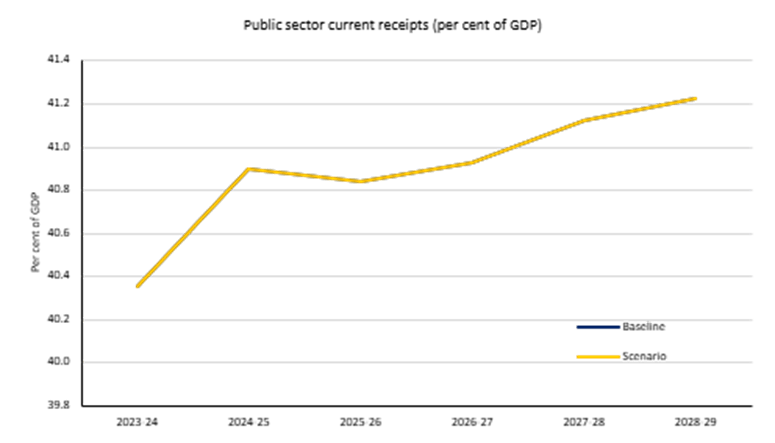
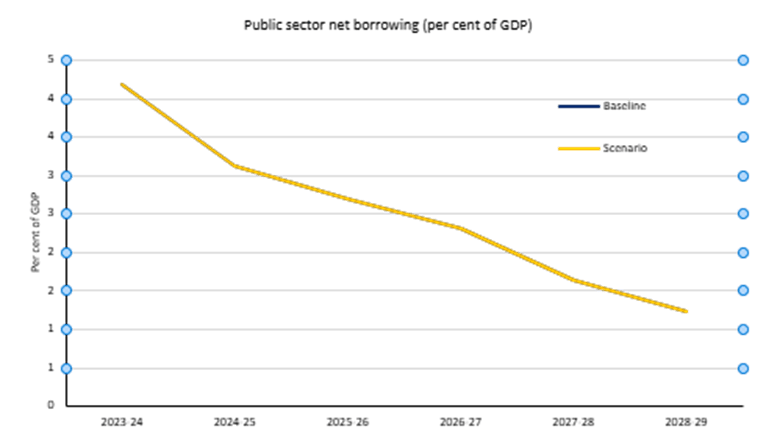
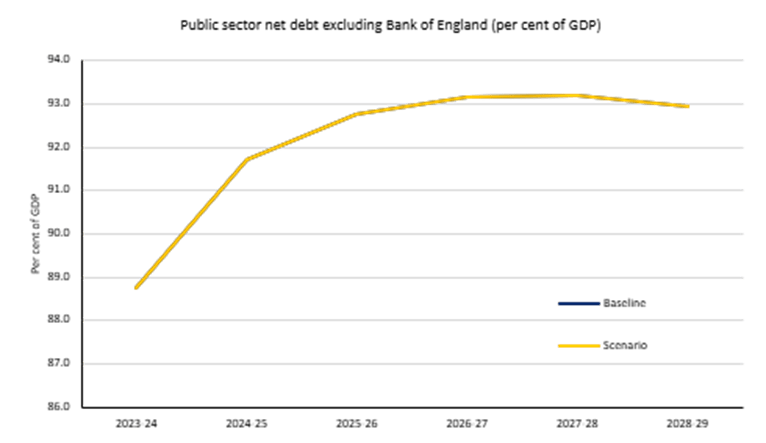
 Research Capacity Ltd
Leave a comment